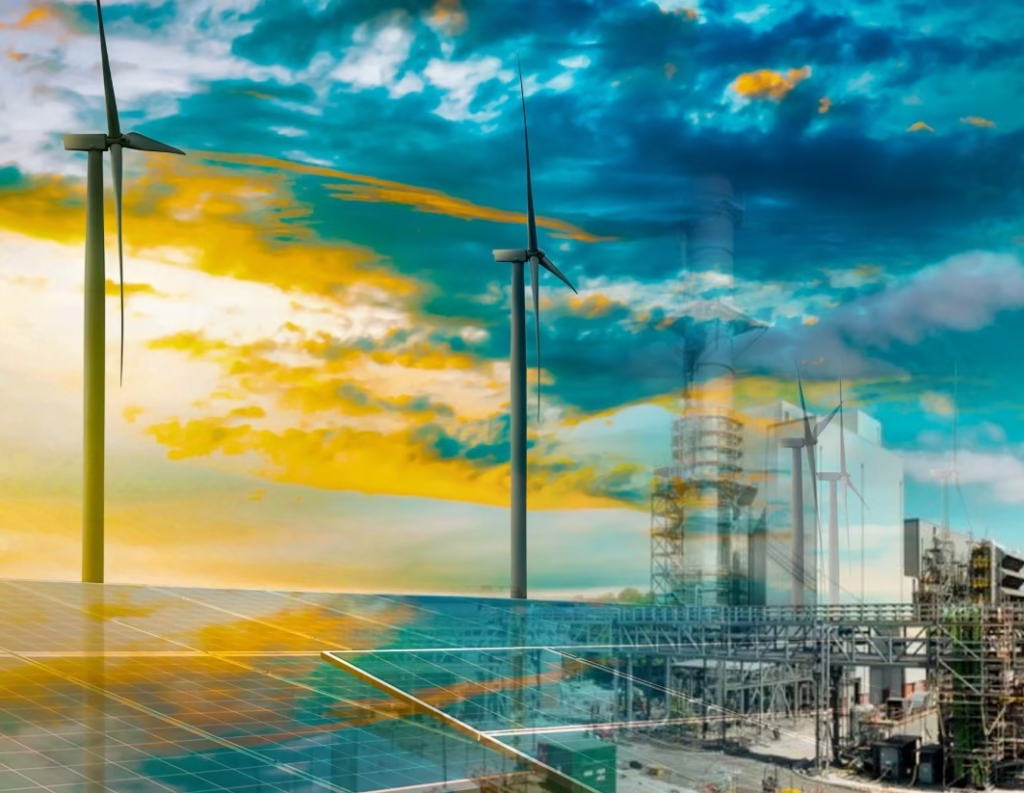
In my previous blogs, I explored SpaceTech as the frontier of expansion and Quantum Computing as the next leap in computational power. Both represent transformative forces shaping the future of humanity. Yet neither can scale without a more fundamental layer: Energy.
Energy is no longer just an infrastructure sector.
It is becoming the central operating system of the global economy and the foundation of the future of civilization. If SpaceTech defines how far we can go, and Quantum defines how fast we can compute, EnergyTech defines whether either of them can exist at a scale. The world is entering a phase where energy is not only about supply, but about security, intelligence, and strategic sovereignty.
Three structural forces are redefining the importance of energy:
- The exponential rise of artificial intelligence and digital infrastructure is driving unprecedented energy demand, with data centers, AI models, and global connectivity systems reshaping consumption patterns at a pace the existing grid was never designed to handle.
- At the same time, energy security has become a core national priority, with countries investing in domestic capabilities to ensure resilience, stability, and geopolitical independence.
- In parallel, the transition to clean energy has moved beyond ideology and is now driven by economics, competitiveness, and long-term cost efficiency. Energy has moved from being a supporting function to becoming a strategic instrument of power.
What we are witnessing globally is not incremental progress but a system level redesign of energy infrastructure.
- The United States is investing heavily in advanced nuclear, energy storage, and grid modernization while aligning energy strategy with artificial intelligence and technological leadership.
- Europe is accelerating its shift toward renewable energy and diversification, turning energy independence into a long-term strategic agenda.
- China and India are scaling rapidly, with China dominating manufacturing across solar, batteries, and critical materials, while India positions itself to meet future demand at scale.
At the scientific frontier, breakthroughs are emerging in nuclear fusion, advanced geothermal systems, long duration storage, and carbon capture technologies. What is fundamentally different today is that innovation is no longer led only by governments. It is being co-led by startups, venture capital, and ecosystem builders.
Fervo Energy is redefining geothermal by applying advanced drilling technologies and enabling scalable baseload renewable energy. Valuation signals have crossed $1B and are trending toward the multi-billion range. IPO timing is realistically within the next one to three years, contingent on project deployment scale and revenue visibility, with exit potential in the $2B to $5B range as an infrastructure scale public platform.
TAE Technologies represents one of the most capital-intensive bets in EnergyTech. According to PitchBook and industry disclosures, it has raised more than $1.2B to date. It remains pre commercial, with projected commercialization toward the end of the decade. IPO timing is unlikely before 2028 to 2032, depending on technical milestones. Exit profile is asymmetric, with potential for a $10B+ platform valuation if successful, or continued private funding if timelines extend.
Antora Energy has raised over $200M, including a roughly $150M round led by institutional investors such as BlackRock and Temasek, as reflected in PitchBook transaction data. Its industrial decarbonization focus provides a clearer revenue pathway. IPO timing could fall within a three-to-five-year window with scaled deployment. Exit profile ranges from strategic acquisition to a public listing in the $1B to $3B valuation range.
Infinitum operates in the efficiency layer of EnergyTech. PitchBook categorizes this segment as enabling technology with lower capital intensity and faster commercialization cycles. While total funding is below billion scale, its positioning supports a likely strategic acquisition within a two-to-four-year timeframe. Exit valuations typically range between $500M and $1.5B depending on market penetration.
Liquid Wind represents a hybrid model combining venture capital with project finance. According to PitchBook profiles and energy transition data, its growth is tied to asset deployment rather than pure venture scaling. IPO timing is longer term, typically five to seven years, requiring multiple operational facilities. Exit profile aligns with infrastructure platforms, with valuation potential exceeding $1B depending on project portfolio scale, or through strategic partnerships with major energy players.
Applied Atomics is taking an execution-first approach to nuclear power. The company is not pursuing novel reactor physics; instead, it is focused on deployable, cost-predictable nuclear power using proven light-water reactor technology, combined with vertical integration and realistic deployment timelines.
What becomes clear is that these are not simply startups. They represent three distinct capital and exit pathways shaping EnergyTech:
- Infrastructure scale companies are moving toward public markets with asset backed valuations.
- DeepTech players are operating on longer, asymmetric timelines with breakthrough dependent outcomes.
- Enabling technologies are driving near term returns through acquisition and industrial integration.
Market data consistently shows that EnergyTech is no longer a single investment category, but a convergence of venture capital, infrastructure capital, and deep science investment, each with fundamentally different timelines, risk profiles, and exit strategies.
Oil and gas are in the equation as of today. But oil is no longer the future.
Today oil and gas still remain deeply embedded in the global economy. Entire industries, supply chains, and national systems still rely on them. Aviation, shipping, petrochemicals, and heavy transport do not yet have scalable alternatives. This is the current reality.
But the direction is clear: oil has shifted from being the engine of growth to being a source of cash and geopolitical leverage. The most successful energy companies are no longer positioning themselves as oil companies. In practical terms, oil is financing the transition away from itself.
This creates a clear divide: the winners will not be those who defend oil. They will be those who use its capital, infrastructure, and global reach to build the next generation of energy systems. The losers will be those who underestimate how quickly innovation in storage, electrification, and alternative fuels will reshape demand.
From a leadership perspective, the question is not whether oil remains relevant today. The question is how to use it strategically while it still dominates, and how to transition before it becomes a constraint rather than an advantage. In the context of my book The Business Caring Formula this is a test of Responsible leadership and true Change Engine capability. It requires clarity, not ideology, and decisive action, not delay.
Oil will not define the future. But it will determine who is prepared for the future.
Energy is shifting from centralized infrastructure to intelligent, distributed, and programmable systems. We are moving toward decentralized models such as microgrids and virtual power plants that increase resilience and democratize access. Artificial intelligence is becoming the orchestrator of energy systems, optimizing production, distribution, and consumption in real time.
Energy itself is evolving into a platform, becoming digitized, integrated into financial systems, and increasingly connected to emerging models such as tokenization and alternative payment infrastructures. This shift aligns directly with platform-based visions like Digital Julfa, where economic ecosystems are built on connectivity, trust, and access. Industries such as manufacturing, logistics, and construction are being redefined based on new energy inputs, not just incremental efficiency gains. At the same time, EnergyTech is converging with other frontier domains, deeply interconnected with artificial intelligence, SpaceTech, and Quantum Computing, reinforcing the reality that no industry operates in isolation.
Closing Vision
In my previous reflections on SpaceTech and Quantum Computing, I focused on where humanity is going and how intelligence will evolve. With EnergyTech, we come back to a more fundamental question: “What will power that future?”
Because without energy, there is no computation.
Without energy, there is no expansion.
Without energy, there is no scale.
SpaceTech, Quantum, and EnergyTech are not separate domains. They are a single, interconnected system shaping the next era of civilization. Energy is the foundation of that system. It is the civilization’s defining force. It will determine which countries lead, which industries transform, and which societies thrive.
Energy transformation is not just a technological shift. It is a leadership challenge. Within the framework of my book The Business Caring Formula, this moment calls for leaders who embody responsibility, inclusiveness, and the ability to drive systemic change. Energy leadership requires a Responsible approach to balancing growth with sustainability. It requires leaders to act as Business Family Builders, creating interconnected ecosystems rather than isolated ventures. It demands Change Engines who can operate at scale while navigating complexity. Energy is the ultimate test of leadership because it impacts every industry, every economy, and every individual.
Just as the New Julfa network once built global influence through trust, strategy, and interconnected trade, today we are called to build intelligent energy ecosystems that enable long term prosperity and global collaboration.
We are not simply transitioning energy sources. We are redefining how the world operates.
And in this new reality, the most impactful leaders will not be those who control resources alone, but those who understand how to connect values and technologies, govern responsibly, and scale impact.