For decades, space was viewed as the distant, expensive, and reserved for governments and astronauts. Today, SpaceTech has quietly crossed a critical level. It is no longer about exploration alone; it is about innovation with immediate impact on earth.
In my last December 2025 blog, How Caring Leadership Can Solve Today’s Crisis of Trust in AI, I explored AI and Agentic AI, highlighting how true leadership can build trust for societies in these transformative technologies. Today, we expand that perspective, examining how AI, Agentic AI, and the accelerating pace of other innovations are shaping the rapidly evolving SpaceTech ecosystem. From satellite intelligence to in-orbit data collection and global connectivity, these forces are not only driving technology beyond Earth but also enabling leaders to use space-based innovations to address some of humanity’s most complex challenges.
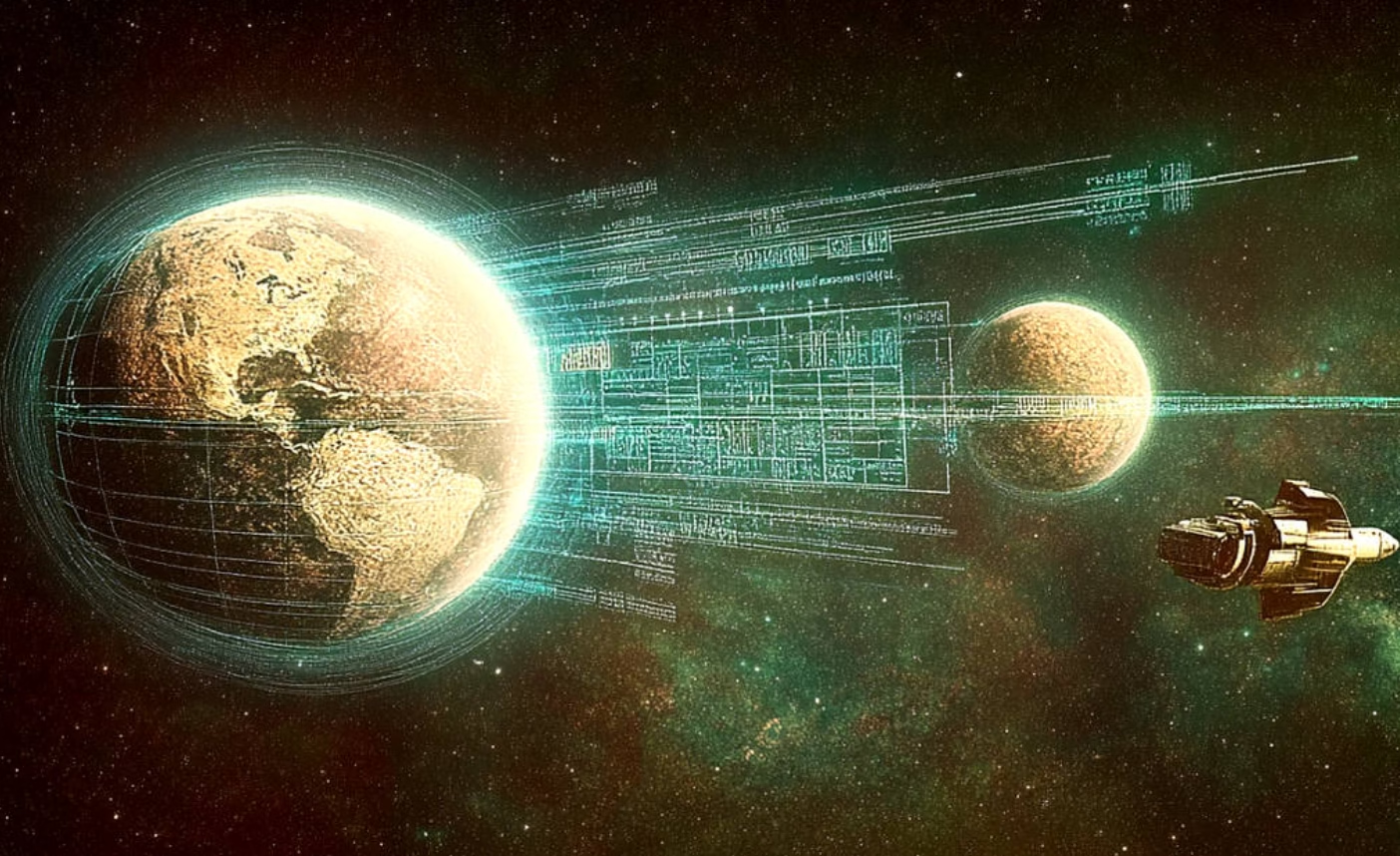
What is unfolding now is not a space race. It is a space-enabled Innovation Economy. From AI driven satellite intelligence and reusable launch systems to in orbit manufacturing, long-duration spacecraft living year-long in space, and space-based connectivity, SpaceTech has become a powerful accelerator for innovation across industries. These spacecrafts collect and analyze data continuously, feeding Earth-based systems with insights that drive climate science, agriculture, logistics, cybersecurity, healthcare, and financial services. Technologies originally designed to operate beyond Earth’s atmosphere are now powering innovations that touch millions of lives. The most important shift is clear: space is no longer far away. It is becoming deeply embedded in how we solve Earth’s most complex problems.
SpaceTech is no longer a single industry. It is an innovation stack, a layered system of technologies, data, governance, and business models that reinforce one another. Satellite intelligence has evolved from passive observation tools into active systems, combining high resolution imaging with AI to enable real time climate and environmental monitoring, predictive analytics for agriculture and disaster response, and supply chain visibility. The transformative element is not the hardware. It is the analytics layer, turning space generated data into actionable insights that impact lives across the globe.
Starlink is not the only company building satellite constellations to connect the world, but it is currently the most widely accessible to individual consumers. Companies like OneWeb (United Kingdom), Amazon Kuiper (United States), Telesat Lightspeed (Canada), and StarNet (China) are developing similar low Earth orbit networks, primarily targeting governments, enterprises, and underserved regions. What sets Starlink apart is its global consumer reach, speed, and low latency, making it a practical solution for everyday internet access anywhere on the planet and enabling a truly space-enabled innovation economy.
Before the 20th century, space was largely about imagination, observation, and philosophy rather than practical exploration or innovation. There were several broad space perspectives:
Mythical and Religious Interpretations: Ancient civilizations saw the sky as the domain of gods and cosmic forces. Planetary events like comets, eclipses, and meteor showers were interpreted as messages from the divine, inspiring myths, storytelling, and cultural traditions.
Philosophical and Scientific Curiosity: Classical philosophers such as Aristotle (Greece), Ptolemy (Egypt/Roman Empire) and Anania Shirakatsi (Armenia) modeled space with Earth at the center. The Renaissance brought revolutionary thinkers like Nicolaus Copernicus (Poland), Galileo Galilei (Italy), and Johannes Kepler (Germany), who revealed the heliocentric system and the laws of planetary motion, showing that space is governed by natural laws, even if it remained distant and inaccessible.
Exploration as Observation: Telescopes invented in the early 17th century allowed humans to study the Moon, planets, and stars in extraordinary detail. Astronomy became a science of mapping and understanding planetary bodies, but space travel remained a dream, explored only in imagination and literature, from early speculative fiction to visionary articles.
Mechanical and Early Rocketry Concepts: By the 18th and 19th centuries, scientists such as Isaac Newton laid the foundation for understanding gravity and orbital mechanics. Early rockets, developed in China and Europe, demonstrated that motion beyond Earth was physically possible, yet space was still seen as largely unreachable for human activity.
It was only with the 20th century, modern rocketry, satellites, and human spaceflight, that space shifted from conceptual curiosity to a practical domain for exploration, connectivity, and economic opportunity. Today, technologies like Starlink, long-duration spacecraft, and in-orbit data collection have turned space into an active, integrated part of Earth’s innovation ecosystem.
Reusable rockets and modular launch platforms have dramatically reduced the cost of reaching orbit. Space is shifting from an elite domain to an open innovation ecosystem, allowing startups and emerging economies to enter the market, experiment faster, and drive new business models. Low Earth orbit satellites, combined with Starlink style constellations and spacecraft collecting year-long data, are expanding global connectivity, enabling resilient communication during disasters, and supporting critical services that touch education, telemedicine, and financial inclusion.
In orbit manufacturing is creating opportunities that cannot be replicated on Earth, from high precision materials and fiber optics to pharmaceutical and biotech experimentation. Meanwhile, governance and security technologies are emerging as critical pillars. Space traffic management, satellite cybersecurity, and international frameworks for responsible activity are essential to prevent instability as the domain becomes crowded and commercially valuable. The true power of SpaceTech lies not only in individual technologies, but in how it multiplies innovation across industries, from climate resilience and precision agriculture to health, infrastructure planning, and financial risk modeling.
SpaceTech innovation places today’s leaders in a position unlike any before. Decisions made now will shape not only markets and technologies, but the future conditions of life on Earth. True leadership in SpaceTech is not defined by who reaches orbit first, but by who ensures space-enabled innovation serves humanity. As space becomes embedded in Earth’s critical systems, leaders must evolve from pioneers to stewards. This means moving from competition alone to cooperative advantage, from innovation speed to innovation wisdom, and from national or corporate gain to planetary outcomes. Leaders must recognize that space infrastructure is becoming a global public utility, even when privately built.
History shows that innovation without governance eventually creates instability. SpaceTech offers a rare opportunity to design governance parallel with technology. Responsible leaders must embed ethical frameworks into SpaceTech development, advocate for international standards on space traffic, data use, and security, and ensure transparency in AI driven satellite intelligence and decision systems. Governance is not a constraint. It is what makes innovation scalable, trusted, and sustainable.
Leadership in SpaceTech should be purpose driven. The most impactful leaders will ask how satellite intelligence can strengthen climate resilience and food security, how space based connectivity can reduce inequality and unlock human potential, and how data from spacecraft living year-long in space can support disaster prevention rather than post crisis response. When aligned with purpose, SpaceTech becomes a force multiplier for human well being, not just technological dominance.
No single country, corporation, or institution can steward space alone. Leaders must encourage cross border collaboration and shared data ecosystems, especially in an era where the 21st century 2020s have seen peace and global governments struggling to negotiate effectively. Supporting public private partnerships with clear societal mandates and building trust frameworks that allow innovation to flow responsibly across nations is essential. SpaceTech demands global leadership maturity, where collaboration is seen as strength, not compromise.
Perhaps the most overlooked responsibility is human capital. Leaders must invest in education systems that integrate space science with ethics, policy, and sustainability, cultivate interdisciplinary talent, engineers who understand governance and policymakers who understand technology, and inspire young generations to see SpaceTech as service to humanity, not escapism from Earth. Innovation lasts only as long as the values that guide it.
SpaceTech forces leaders to confront a profound truth. We are expanding our technological reach faster than our collective wisdom. The leaders who define this era are those who lead with foresight, not fear, govern with care, not control, and innovate with humanity at the center. Space is not an escape plan. It is a mirror reflecting how responsibly we choose to shape our future together.
My Perspective
I believe that true caring leadership will use technology to make a positive impact on mankind. Space innovation results, from satellite intelligence to spacecraft collecting data year-long in orbit, should not only advance knowledge but also help fix issues on our planet and create a positive impact on the universe as well. This can only be achieved if leaders of innovation, governments, and corporations care deeply about the consequences of their actions and focus on impact rather than profit alone. In my book The Business Caring Formula, I outline key ingredients of caring leadership such as responsible leadership, inclusivity, passion guided by values, and empowering others, which together form a leadership lifestyle that puts human and planetary well-being at the core of decision-making.
By aligning SpaceTech and AI driven innovations with a purpose in addition to financial gain, leaders can ensure that humanity and the planet benefit from the extraordinary capabilities we are now building in space.